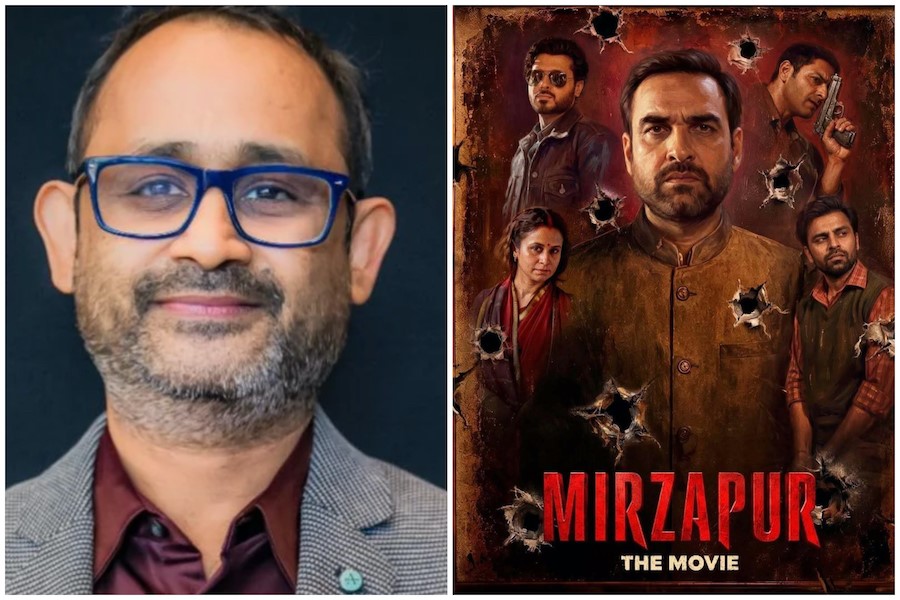
Reflecting on the audience's response to the film, especially after the success of the web series, Puneet said, “Absolutely wonderful!” He admitted that the team initially had no clear blueprint for transforming a web series into a theatrical film. “We weren’t even sure how to adapt a series into a film—much like when we first started making the series; we had no prior blueprint, as the concept of web series was virtually non-existent in India at the time. We relied on common sense, aiming to create something that the audience would genuinely enjoy.” Explaining how the team approached the film, he added, “We approached the film with the same mindset: since the series was so well-loved, we wondered if there was a story within it that could be presented as a feature film in cinemas—something the audience would appreciate. That was our approach, and we are incredibly happy that the film has been such a success.”
Puneet's own journey into the entertainment industry was far from conventional. Despite studying engineering, pursuing an MBA and working in the corporate sector, his ambition to make films never disappeared. He originally wanted to become a director and began his career as an assistant director. However, an unexpected suggestion changed his professional path. Recalling how he became a writer, he said, “Yes, that’s correct. I started out working as an Assistant Director (AD). I had a strong desire to work in films—to create them—and I was told that becoming an AD was a stepping stone toward that goal, so I took that path.” He continued, “Then, during one project, the director remarked that I had a good command of language and suggested I try writing. He asked me to write the very film I was working on as an AD. That’s how I became an ‘accidental’ writer.”
Even while working in the corporate world, Puneet continued to nurture his creative ambitions. However, he never imagined that his work would eventually receive such widespread appreciation. “Even while I was in the corporate world, I always had this aspiration, but I never imagined we would create something that would receive such immense love from the audience. We feel truly lucky and blessed,” he said. Looking back at his journey, he expressed no desire to rewrite his past, despite the challenges he encountered. “If someone were to ask me, ‘Would you want to live the exact same life all over again?’ I would say yes—down to the very same mistakes and the same challenges. Those difficulties were an integral part of my journey.” He also acknowledged the people who stood beside him, adding, “And, of course, none of this would have been possible without the support of the people around me—my family and loved ones. I would choose to live this life exactly the same way again.” Grateful for where life has taken him, he said, “I feel that everything has unfolded just as it should have, and I’m grateful for the opportunity to sit here and talk with you today. This is happening because things have been moving in a certain direction—and, honestly, I think a bit of luck played a role in that, too.”
His corporate background also plays a practical role in the stories he creates. Puneet explained that whenever his writing involves business transactions, he pays close attention to getting the technical details right. Using Kaleen Bhaiya as an example, he said, “For instance, when Kaleen Bhaiya engages in business dealings—whether it’s a deal involving carpets, drugs, firearms, or discussions around profit, loss, supply, and demand—my corporate background definitely comes into play.” He added that its influence extends beyond the scripts themselves: “Beyond the stories themselves, my corporate background likely influences how I interact with people in our industry and how I approach my work.” This attention to detail helps ground the fictional world of Mirzapur in the practical realities of money, business and power.
Adapting the popular series into a film was another major challenge, and Puneet was aware of the stakes from the beginning. He admitted, “I didn’t overthink it too much, but I was well aware that it was a high-pressure, risky undertaking.” He explained why the responsibility weighed heavily on the team: “People love our series so much that if the film didn’t work, it could harm both the series and our legacy—that was always in the back of my mind.” Despite the pressure, the team refused to let commercial expectations dictate the creative process. “Beyond that, we didn’t set out with the goal of creating a massive hit. We simply aimed to make something good; if it’s good, it will naturally become a hit. So, the focus was on quality rather than commercial success,” he said.
Puneet also reflected on the casting philosophy that helped shape the original series. When he and his collaborator Guru Bhai began working on Mirzapur, they were still finding their footing after earlier projects failed to make an impact. “We were new to this, too. Guru Bhai and I had previously worked on projects that didn’t quite take off—or, in Bollywood terms, they were flops. We were just looking for talented actors,” he recalled. According to Puneet, the OTT format gave them the freedom to choose performers based on ability rather than star power. “We realized that, unlike films, the OTT medium allowed us to work with skilled actors rather than chasing ‘stars,’ since we weren’t concerned with Friday box-office numbers. This gave us the freedom to find actors who could truly embody these characters.”
He also understood that streaming audiences would not hesitate to abandon a show if the performances failed to impress. “We also understood that if an actor couldn’t deliver a strong performance, the audience—who can be quite brutal and ruthless—would simply click away to another show or stop watching altogether. After all, when people are at home, it’s incredibly easy for them to just switch off.” Rather than viewing their casting decisions as risky experiments, the team focused on finding the right people for every role. “So, we were on the lookout for good actors, and I feel we were lucky to have found such talented ones. We weren’t really taking a risk; we were simply searching for good actors, and as it turned out, we found them. For each and every character, we were lucky to find the right actors for every single character,” he concluded.
From becoming an accidental writer to building a hugely popular franchise, Puneet Krishna's story is one of ambition, resilience and trusting the creative process. His reflections reveal that the success of Mirzapur was not built on a guaranteed formula, but on instinct, attention to detail and a commitment to choosing quality over convention. With Mirzapur: The Movie taking the franchise into cinemas, Puneet's journey shows how an uncertain creative experiment can grow into a cultural phenomenon when the story and its characters connect with audiences.
News Helpline is a Brand in the world of daily Bollywood Content. We are a team of Innovative, Hard working and Creative people working in media since last 15 years. We were the first to sense the changing phase of News Industry with the progress of IT industry. Hence in the year 2008 we came up with a first of its kind Bollywood News Application, a website where we uploaded Bollywood news on daily basis and our client could download this news from anywhere in the world on the same day of the event. Then with the passage of time we improved and evolved. The result is today our client in any area of the world receives their Bollywood news (HD quality) within 2-3 hrs. post event. The value of News is very Time dependent and we at News Helpline deliver the News before thay become rumors.
This website uses cookies.


